

AI Automation Specialist vs AI Developer Cost in 2026: Choose the Right Hire From $1,750/Month
July 19, 2026 · Borderless Recruit Team
The AI automation specialist vs AI developer cost decision depends on whether you need to configure existing tools or build proprietary software. A US automation specialist averages $6,372 per month in base pay, compared with $10,779 for a US AI developer. After statistically typical private-industry benefit costs, those estimates rise to approximately $9,117 and $15,422 per month. Current Philippine postings show roughly $1,000-$3,000 for automation specialists and $1,280-$1,920 for AI developers, while Latin American AI/ML engineers typically cost more but provide greater US-time-zone overlap.
AI Automation Specialist vs AI Developer Cost: Quick Comparison
An AI automation specialist is usually the less expensive hire because the role configures proven platforms rather than engineering an entire application. According to ZipRecruiter and March 2026 Bureau of Labor Statistics data, a US AI developer averages $10,779 per month in base pay and approximately $15,422 per month after statistically typical private-industry benefit costs, before general corporate overhead. The corresponding estimates for a US AI automation specialist are $6,372 and $9,117 per month.
AI automation specialist versus AI developer responsibilities and costs
| Comparison | AI automation specialist | AI developer |
|---|---|---|
| Primary outcome | Automated workflows across existing business tools | Custom, maintainable AI software or product features |
| Typical tools | Zapier, Make, n8n, HubSpot, CRMs, help desks, APIs and LLM prompts | Python, JavaScript or TypeScript, model APIs, databases, cloud infrastructure and evaluation frameworks |
| US average base pay | $6,372 per month | $10,779 per month |
| Estimated US compensation with typical benefits | $9,117 per month | $15,422 per month |
| Observed Philippines rates | Approximately $1,000-$3,000 per month across current postings and seniority levels | $1,280-$1,920 per month in a documented $8-$12 hourly posting |
| Best fit | Stable processes supported by existing APIs and SaaS tools | Proprietary logic, custom interfaces, sensitive data, complex scale or product ownership |
| Main limitation | Dependent on platform limits, vendor pricing and available connectors | Higher build cost, longer delivery cycle and greater maintenance burden |
The BLS reported that benefits represented 30.1% of total private-industry compensation in March 2026. Because wages represented the remaining 69.9%, benefits were equivalent to approximately 43.1% on top of wages, not simply a 30.1% salary markup. These benefits include paid leave, insurance, retirement, supplemental pay and legally required benefits. Recruiting, equipment, management, office space and turnover remain additional costs.
What Each AI Role Actually Does
The practical dividing line is configuration versus software engineering. An automation specialist maps a business process, connects existing systems and designs rules for normal cases, exceptions and human escalation. An AI developer creates and maintains custom applications, agents, pipelines and infrastructure when ready-made tools cannot meet the requirement.
AI automation specialist
An automation specialist might connect a website form to HubSpot, enrich the lead with an AI model, assign a score, create a sales task and send low-confidence records to a person for review. The work combines process discovery, n8n, Make or Zapier configuration, API integration, prompt design, data mapping, error handling and monitoring. Light JavaScript or Python may be required, but reusable business workflows are the primary deliverable.
AI developer
An AI developer writes production software around models. Deliverables can include a custom retrieval-augmented chatbot, a multi-tenant AI feature for a SaaS product, an agent with permission controls, a document-processing pipeline or an evaluation system that tests accuracy before deployment. The role requires software architecture, version control, automated testing, database design, API security, observability and maintainability—not just prompting a model.
AI engineer, ML engineer and full-stack developer
Titles overlap, so evaluate deliverables rather than labels. An AI engineer commonly integrates foundation models into reliable production systems. An ML engineer focuses more heavily on data pipelines, model training, deployment and performance. A Full-Stack Developer builds interfaces, APIs and databases and may integrate AI without training models. A prompt engineer specializes in instructions and evaluation but is rarely a substitute for production engineering or end-to-end workflow ownership.
Demand is moving toward broader agent skills. Stanford's 2026 AI Index counted 16,541 US job postings mentioning agentic AI in 2025, up from 151 in 2024; postings mentioning AI agents rose from 1,310 to 15,217. PwC found an average 62% wage premium for AI-skilled roles in 2025, although that estimate does not control for every difference in education, experience or location.

AI Automation Specialist vs AI Developer Cost by Hiring Model
The engagement model changes both the invoice and the risks retained by your company. A freelancer can be efficient for a bounded pilot. A dedicated employee offers continuity and institutional knowledge. An agency can supply multiple disciplines, while an offshore staffing or employer-of-record arrangement can provide full-time capacity with local payroll and employment administration.
How hiring models affect AI talent cost and ownership
| Hiring model | Cost structure | Best use | Cost or operational risk |
|---|---|---|---|
| US employee | Salary plus benefits equivalent to about 43.1% of wages, then recruiting, equipment and overhead | Long-term work requiring daily control | Highest fixed cost and exposure to vacancy or turnover |
| Offshore employee or compliant managed hire | Monthly compensation or flat invoice with locally administered employment | Ongoing delivery and embedded team membership | Vendor quality, communication and access controls require verification |
| Freelancer | Hourly or fixed-project quote | Experiment, audit or clearly bounded implementation | Quote may exclude maintenance, documentation, security and continuity |
| Agency | Discovery, project and often maintenance fees | Defined outcome requiring several specialties | Less visibility into individual allocation and potentially costly change requests |
Convert every proposal to a 12-month total cost of ownership. At the cited averages, a US automation specialist costs approximately $76,464 in annual base pay or $109,404 after typical benefits. A US AI developer costs about $129,348 in base pay or $185,064 after typical benefits. A Philippine AI developer posting at $1,280-$1,920 per month translates to $15,360-$23,040 annually before any staffing, equipment or management charges.
For projects, require separate estimates for discovery, implementation, testing, documentation, training and post-launch support. An $8-$12 hourly development posting implies $1,280-$1,920 for 160 hours, but that arithmetic is not a universal project quote. Fixed-price work may include a risk premium, while hourly work transfers scope risk to you. Use the savings calculator to compare recurring monthly and annual costs under consistent assumptions.
Outcome-based contracting is also expanding. Deloitte reports that 67% of surveyed organizations had adopted outcome-based outsourcing models emphasizing measurable results and innovation. Useful outcomes include hours eliminated, error rates, resolution rates, deployment frequency and revenue generated—not the number of workflows or prompts produced.
US vs Offshore AI Hiring Costs
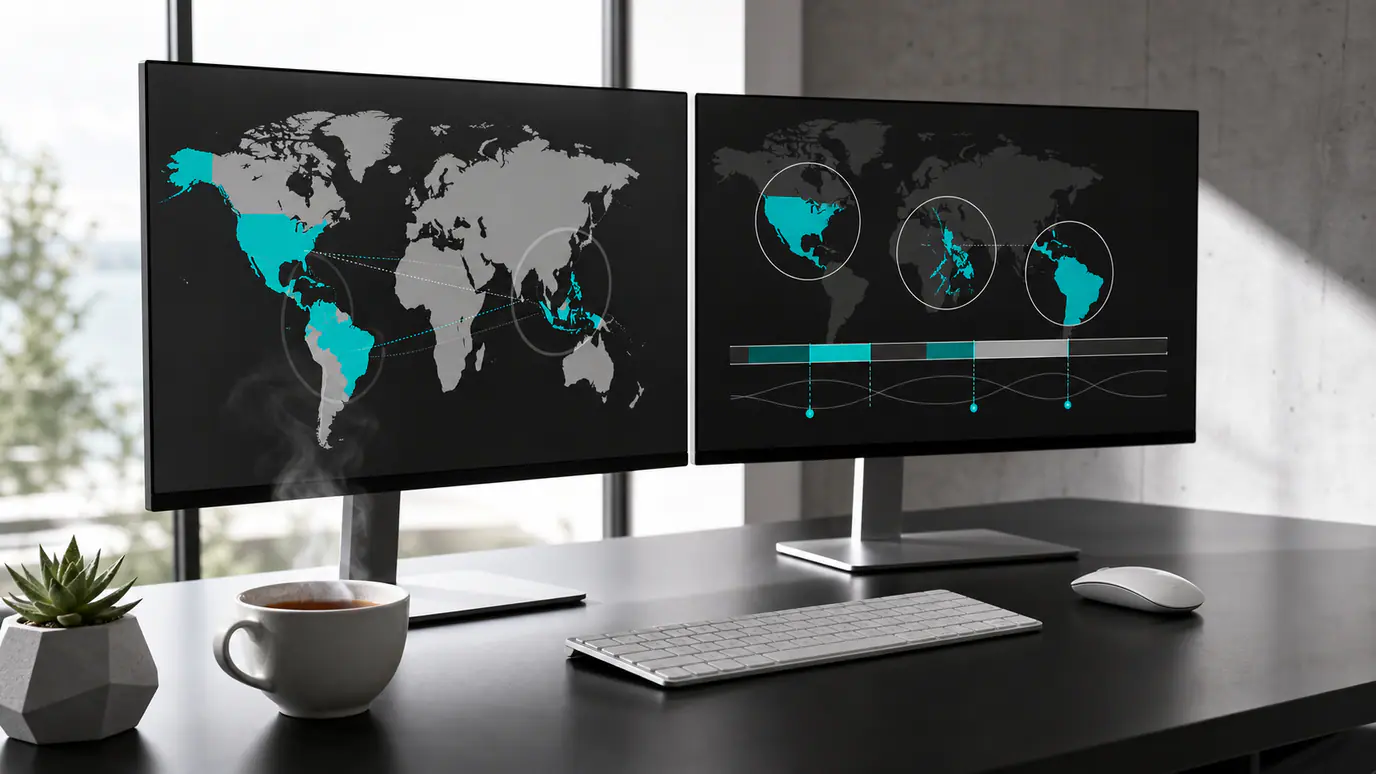
Offshore AI talent can reduce direct labor cost by 35% to more than 80%, but the comparison must account for role level, benefits, location and service fees. According to current OnlineJobs.ph postings, Philippines-based AI automation specialists are being advertised from roughly $1,000 to $3,000 per month, versus a $6,372 US average base salary for the same broad title.
US, Philippines and Latin America AI and software talent benchmarks
| Role and location | Base compensation | Estimated or reported all-in compensation | Comparison |
|---|---|---|---|
| US AI automation specialist | $4,750-$8,208 monthly at the 25th-75th percentiles; $6,372 average | $6,795-$11,742 monthly; approximately $9,117 average after typical benefits | Reference benchmark from ZipRecruiter and BLS |
| Philippines AI automation specialist | Observed postings from about $800-$1,000 for chat automation, $1,000-$2,000 for a current full-time role and $2,000-$3,000 for a senior Level 3 role | Posting figures do not establish a universal all-in cost | About 69%-84% below the US average base at $1,000-$2,000 |
| US AI developer | $8,833-$13,083 monthly at the 25th-75th percentiles; $10,779 average | $12,638-$18,718 monthly; approximately $15,422 average after typical benefits | Reference benchmark from ZipRecruiter and BLS |
| Philippines AI developer | $1,280-$1,920 monthly based on a documented $8-$12 hourly posting | Posting does not include a universal staffing or overhead allowance | About 82%-88% below the US average base |
| Latin America mid-level AI/ML engineer | $5,000-$6,333 monthly; $5,500 median | Approximately $7,833 monthly in reported all-in employer cost | About 41%-54% below the US AI-developer average base |
| Latin America senior AI/ML engineer | $5,500-$7,000 monthly; $6,000 median | Approximately $8,583 monthly or $103,000 annually | Reported all-in cost is 35.6% below a $160,000 US comparison by direct arithmetic |
| US software developer | $11,090 monthly median; $6,654-$17,621 at the 10th-90th percentiles | Approximately $15,865 monthly at the median after typical benefits | BLS broader software-development benchmark |
| Latin America software developer | Approximately $4,438 monthly in Brazil to $5,264 in Argentina across 2025 payroll records | Varies with employment, benefits and vendor structure | About 53%-60% below the US median base |
According to Revelo's signed-placement data, mid-level Latin American AI/ML engineers earn a median $5,500 per month and senior engineers earn $6,000, with typical ranges of $5,000-$6,333 and $5,500-$7,000 respectively. Latin America generally offers stronger overlap with US working hours. Philippine talent can provide lower direct costs, but employers may need planned overlap windows, asynchronous documentation and carefully designed escalation coverage.
These are not perfectly like-for-like datasets. Philippine figures include individual job postings rather than a statistically representative national salary survey. Revelo reports signed placement data and all-in employer costs. Validate a budget using several comparable candidates, identical assessment criteria and written definitions of what the fee includes.
The talent pools are substantial. According to IBPAP data reported by the Philippine News Agency, the Philippine IT-BPM sector generated $38 billion in 2024 revenue, employed 1.82 million people and added 120,000 direct jobs during the year. CBRE found that technology employment across Latin American markets grew 55% between 2019 and 2024, more than three times the US rate.
Which Projects Need an Automation Specialist or AI Developer?
Choose an automation specialist when the required systems already exist and choose an AI developer when the software itself creates differentiation. The wrong hire often begins with an imprecise request such as automate customer service. Define the data, systems, volume, success threshold, exceptions and ownership before selecting a title.
Use an AI automation specialist when
- The process moves information among tools such as HubSpot, QuickBooks, Xero, Slack, Gmail, Shopify, a help desk or a project-management platform.
- Zapier, Make, n8n or supported APIs can perform most of the work without a proprietary application.
- The workflow has stable rules, moderate volume and clear human-escalation conditions.
- You need rapid deployment, process documentation and continuous workflow optimization more than custom software.
- Examples include lead routing, invoice extraction, support-ticket triage, CRM updates, reporting and campaign handoffs.
Use an AI developer when
- AI is a customer-facing product feature or a source of competitive differentiation.
- The system requires a custom interface, proprietary business logic, complex permissions or integration with an internal application.
- You need retrieval pipelines, model evaluation, automated tests, observability, version control and deployment infrastructure.
- The workload has high scale, strict latency or reliability requirements, or regulated and sensitive data.
- Examples include a multi-tenant SaaS copilot, custom document-intelligence platform, production agent system or proprietary recommendation engine.
A hybrid team is often the practical answer. An automation specialist can map operations, configure standard connectors and maintain business workflows while an existing US engineer reviews architecture, security and code. Hire an offshore AI developer for the custom components only when platform limits, proprietary logic or reliability requirements justify engineering work. This division protects expensive development capacity from being consumed by routine SaaS configuration.
Apply a simple scoping test: Can the workflow be diagrammed as triggers, actions, conditions and human escalations using available APIs? If yes, start with an automation specialist. If success depends on custom state management, user permissions, proprietary algorithms, extensive testing or a new application, use an AI developer. Run a paid pilot before expanding an uncertain scope into a permanent role.
How to Vet and Onboard Offshore AI Talent
Vetting should reproduce the work the candidate will perform, not reward memorized AI terminology. Start with a live communication interview, then use a time-boxed practical assessment based on a sanitized business process. Ask the candidate to explain assumptions, failure modes, security controls and maintenance decisions.
Sample offshore AI candidate scorecard
| Criterion | Weight | Evidence to request |
|---|---|---|
| Relevant delivery skill | 30% | Working workflow or code sample using the tools required by your scope |
| Reliability and error handling | 20% | Retries, idempotency, logging, monitoring and human escalation |
| Security and data practices | 20% | Least-privilege access, secret management, audit logs and data-retention controls |
| Communication and documentation | 15% | Clear process diagram, written assumptions and concise status update |
| Maintainability | 10% | Versioning, tests, naming standards and handover documentation |
| Time-zone fit | 5% | Confirmed overlap hours and an escalation plan |
For an automation specialist, provide a broken workflow and ask the candidate to map data, configure a repair and demonstrate a low-confidence escalation. For a developer, request a small API-backed application with tests, authentication assumptions, structured logs and a short architecture note. Do not use unpaid production work as an assessment.
- Ask how the candidate prevents duplicate actions when a webhook is delivered twice.
- Ask where API credentials will be stored and who can retrieve them.
- Ask how prompts, models and workflow versions will be tested before release.
- Ask what happens when a model, vendor API or automation platform is unavailable.
- Ask how intellectual property, repositories, documentation and accounts will be transferred if the engagement ends.
Use company-owned accounts, role-based access, multifactor authentication, scoped API keys and separate development and production environments. The contract should assign intellectual property, define confidentiality and data-processing duties, identify approved subcontractors and require access removal at termination. Worker classification and local employment compliance should also be reviewed for long-term embedded hires.
A four-week onboarding sequence can move from discovery to controlled production: document the process and baseline in week one; shadow users and build in a sandbox in week two; run a limited pilot with human review in week three; and release the approved workflow with monitoring in week four. Treat this as a planning template, not a universal delivery guarantee. Track time to shortlist, assessment pass rate, time to first production outcome and documented system coverage.

How to Calculate ROI and Payback
Automation ROI should be calculated from verified hours, errors or revenue outcomes rather than optimistic percentages. For an internal workflow, estimate monthly hours avoided, multiply by the fully loaded hourly cost of affected employees, and subtract the specialist, software and oversight costs. Divide the initial implementation cost by monthly net benefit to estimate payback.
Practical ROI formulas for AI hiring
| Measurement | Formula |
|---|---|
| Monthly labor value | Verified hours saved × fully loaded hourly labor cost |
| Monthly net benefit | Labor value plus incremental gross profit minus talent, software, model and oversight costs |
| Payback period | Initial implementation cost ÷ monthly net benefit |
| Annual ROI | Annual net benefit ÷ total annual investment × 100 |
| Quality adjustment | Subtract rework, error remediation and expected incident costs from the benefit |
Consider a workflow that saves 250 hours per month at a verified fully loaded labor cost of $30 per hour. Its monthly labor value is $7,500. If talent, software, model usage and oversight total $3,000, the net monthly benefit is $4,500. A $9,000 implementation cost would have a two-month simple payback, provided the savings persist and do not merely shift work to another team.
Published examples show why measurement matters. ClickUp reported reducing support research from 15 minutes to four minutes across more than 5,000 monthly tickets, saving more than 917 hours per month. Mercari's Zapier-based orchestration handles first replies for 97% of about 120,000 monthly tickets, fully resolves roughly 47,000 and frees more than 3,000 support hours per month; failed or low-confidence cases return to humans.
Custom development can create value through revenue, speed or product retention rather than labor reduction. GitHub's controlled research found developers completed a coding task up to 55% faster with Copilot. In its Accenture study, more than 80% of participants adopted Copilot and 67% used it at least five days per week. However, Stack Overflow's 2025 survey found that 46% of developers distrusted AI output accuracy, so human review and tests remain budget items.
Implementation is equally important. The San Antonio Spurs began with 150 pilot users, training, custom onboarding and an internal hackathon before expanding AI adoption; the organization reports saving 1,800 staff hours per month. Baseline the process before deployment, measure adoption and accuracy during a pilot, then expand only after the unit economics survive real operating conditions.
How to Choose the Right AI Hire
Choose the lowest-complexity role that can reliably own the required outcome. An automation specialist is the default for connecting established business applications. An AI developer is justified when you need proprietary software, strict engineering controls, custom user experiences or sustained product development.
- Write the business outcome and baseline: hours, error rate, cycle time, support volume or revenue.
- List every system, data source, API, user role and compliance constraint.
- Separate must-have custom behavior from features already available in SaaS products.
- Classify the work as configure, integrate or build; assign the role only after this classification.
- Choose employee, freelancer, agency or managed offshore talent based on duration, system access and continuity requirements.
- Run a practical assessment and paid pilot using measurable acceptance criteria.
- Include documentation, monitoring, maintenance, intellectual-property ownership and replacement coverage in total cost.
Outsourcing is already a mainstream small-business strategy. According to Clutch's survey of 500 US SMB decision-makers, 84% already outsourced some operations, 70% planned to increase outsourcing in 2025 and 47% prioritized outsourcing AI initiatives. Cost was not the only consideration: 81% emphasized communication, 78% industry knowledge, 77% ROI and 65% cost effectiveness.
Remote integration is also an established operating model. BLS counted 35.5 million US teleworkers in the first quarter of 2024, representing 22.9% of people at work. Gallup's May 2026 indicator found that 26% of remote-capable employees were fully remote and 52% hybrid. Set documented overlap hours, weekly demonstrations, written decision logs and named owners for approvals instead of treating location as a substitute for operating discipline.
Through Borderless Recruit, a vetted, dedicated full-time AI developer starts at $1,750 per month and works exclusively for the client during agreed US hours. Review the AI Developer service page to compare the model with your scope, then use the contact page to discuss technical requirements, vetting, local contracts, payroll, HR and replacement coverage. Keeping deliverables, risk and total ownership in the same model produces a more useful AI automation specialist vs AI developer cost comparison than salary alone.
Frequently Asked Questions
What is the difference between an AI automation specialist and an AI developer?
An AI automation specialist connects existing tools such as Zapier, Make, n8n, HubSpot and model APIs to automate business processes. An AI developer writes and maintains custom software, data pipelines, agents, evaluation systems and production infrastructure when platform configuration is insufficient.
How much does it cost to hire an AI automation specialist?
ZipRecruiter reports a $6,372 average monthly US base salary, while applying March 2026 BLS benefit data produces estimated employer compensation of about $9,117 per month before recruiting, equipment and overhead. Current Philippines postings show approximately $1,000-$3,000 per month depending on scope and seniority, although individual postings are not a national salary survey.
How much does it cost to hire an AI developer?
A US AI developer averages $10,779 per month in base pay and an estimated $15,422 with statistically typical private-industry benefits. A documented Philippines remote posting offered $8-$12 per hour, equivalent to $1,280-$1,920 at 160 hours per month, while Latin American mid-level AI/ML placements had a $5,500 monthly median.
Is AI automation cheaper than custom AI development?
AI automation is usually cheaper when existing platforms and APIs can support the workflow. The US average base salary for an automation specialist is $4,407 per month lower than the AI-developer average, but platform subscriptions, model usage, maintenance and exception handling still belong in the total cost.
Do I need an AI automation specialist or a full AI developer?
Choose an automation specialist for stable workflows that can be expressed as triggers, actions, conditions and human escalations. Choose a developer when you need proprietary logic, a custom interface, complex permissions, high-scale infrastructure, formal testing or an AI feature that customers will use directly.
Is the Philippines or Latin America better for offshore AI talent?
The Philippines generally offers the lowest observed direct rates, including automation postings around $1,000-$3,000 per month and one AI-development posting at $1,280-$1,920. Latin American AI/ML placements are higher at roughly $5,000-$7,000 in base pay but commonly provide more overlap with US working hours; compare technical depth, communication and total employer cost rather than location alone.