

How to Hire API Integration Developer for SaaS Startup Teams in 2026
September 21, 2026 · Borderless Recruit Team
A SaaS startup should hire a dedicated API integration developer when integrations are an ongoing product responsibility rather than a one-time connector. The developer should own API design, OAuth and service-account authentication, webhooks, data mapping, retries, idempotency, rate-limit handling, automated tests, monitoring, documentation, and vendor-change maintenance. A full-time Philippine developer can be a practical choice when the roadmap contains recurring integrations and the startup can provide clear technical leadership, secure access, written acceptance criteria, and defined working-hour overlap.
Do not hire from a vague brief such as “connect our CRM to the product.” First identify the systems, data objects, source of truth, synchronization direction, security requirements, expected volume, failure behavior, and support owner. Use a freelancer for a bounded connector, an agency for a defined project requiring several disciplines, and a dedicated developer when authentication, customer onboarding, incident response, documentation, and provider changes require continuing ownership. For low-code workflows centered on n8n, Make, or Zapier, an automation specialist may be more appropriate than a product API engineer.
What an API integration developer owns in a SaaS startup
An API integration developer turns external systems into a reliable part of the product. That includes building public or internal REST endpoints, integrating CRM and billing platforms, processing webhooks, synchronizing records, creating import and export pipelines, and exposing product capabilities to workflow tools. The role also includes the less visible work that determines whether an integration survives production: credential rotation, error classification, reconciliation, logging, alerts, runbooks, version migrations, and deletion or consent workflows.
- Discovery: document business events, systems, data owners, customer-specific configuration, volume, latency expectations, and regulatory constraints.
- Implementation: build API clients, endpoints, queues, webhooks, transformation logic, and connectors for CRMs, billing systems, support platforms, n8n, Make, or Zapier.
- Reliability: implement idempotency, bounded retries with backoff, timeouts, rate-limit handling, dead-letter processing, replay tools, and scheduled reconciliation.
- Security: use scoped credentials, managed secrets, authorization checks, audit logs, dependency review, and documented credential-rotation procedures.
- Quality: maintain unit, integration, contract, and end-to-end tests against representative payloads and failure conditions.
- Operations: monitor latency, errors, webhook age, queue depth, data drift, token expiration, and vendor deprecations.
- Developer experience: maintain OpenAPI specifications, setup guides, sample requests, typed errors, changelogs, and troubleshooting runbooks.
API work is often a product function rather than a ticket queue. Postman’s survey of more than 5,700 developers, architects, and executives found in 2025 that 82% of organizations had adopted some level of API-first development, 25% were fully API-first, and 69% of respondents spent at least 10 hours each week on API work. The survey also found that 65% of organizations generated revenue from APIs and 46% planned to increase API investment during the following year. Postman 2025 State of the API Report
When to hire a specialist instead of assigning a full-stack developer
Choose the role according to the work that must be owned
| Role | Best fit | Important limitation |
|---|---|---|
| API integration developer | Several production integrations, public APIs, complex synchronization, OAuth, webhooks, queues, testing, and continuing vendor maintenance | May need separate front-end, data, security, or infrastructure support |
| Integration or automation specialist | Business workflows in n8n, Make, Zapier, CRMs, marketing platforms, and internal operations | Low-code experience alone does not demonstrate production backend engineering |
| Full-stack developer | Integrations are one part of broader product work spanning the user interface, backend, and database | May lack deep experience with distributed failures, developer-facing APIs, and vendor governance |
| AI developer | RAG, model APIs, tool-calling agents, evaluations, prompt and retrieval pipelines, and AI-specific observability | Still needs conventional API, security, data, and operational engineering |
A specialist becomes easier to justify when failed integrations affect customer activation, billing, reporting, or retention; the backlog spans several providers; engineers repeatedly interrupt roadmap work to repair sync failures; or a public API has become part of the product. A generalist can remain the better hire when integration work is occasional and the larger need is application development. For broader startup staffing choices, see the dedicated development team guide.
Define the integration before writing the job description
A useful hiring brief starts with one representative integration and describes it as an operating system, not just a list of endpoints. Give candidates enough detail to discuss design trade-offs without exposing production secrets. The brief should state which application is authoritative for each object, how conflicts are resolved, what happens after partial failure, and who responds when an external provider changes its API.
API integration scoping template
| Scope field | Questions to answer | Example acceptance evidence |
|---|---|---|
| Systems and objects | Which product, CRM, billing, support, or data systems connect? Which customers, contacts, subscriptions, invoices, or events move? | Approved data map showing fields, ownership, transformations, and prohibited data |
| Direction and timing | Is the flow one-way or bidirectional? Is it synchronous, event-driven, scheduled, or backfilled? | Sequence diagram and documented source of truth for every synchronized object |
| Authentication | Does the provider use OAuth, API keys, signed webhooks, service accounts, or customer-managed credentials? | Successful authorization, refresh, revocation, scope, and expired-token tests |
| Failure behavior | What happens after timeouts, duplicate events, malformed payloads, provider outages, or rate limits? | Idempotency tests, retry policy, dead-letter handling, replay procedure, and operator alerts |
| Scale and performance | What are the expected and peak event volumes, payload sizes, concurrency, latency, and provider quotas? | Load-test results and dashboards tied to explicit service objectives |
| Change management | How are schema changes, API versions, feature flags, sandbox differences, and deprecations handled? | Contract tests, version policy, migration plan, changelog, and named owner |
| Completion | Who approves security, functionality, documentation, and operational readiness? | Reviewed code, passing tests, runbook, dashboards, rollback plan, and knowledge-transfer session |
Essential technical skills and SaaS experience
Match the language and framework to the existing product rather than hiring from a generic checklist. Common environments include TypeScript or JavaScript with Node.js, Python, Java, C#, Go, and PHP; relational databases; queues; containers; and AWS, Azure, or Google Cloud. Strong candidates can explain HTTP behavior, REST conventions, pagination, schema evolution, transactions, eventual consistency, caching, rate limits, and the difference between transport success and business success.
- Authentication and authorization: OAuth 2.0 flows, refresh tokens, revocation, service accounts, signing, tenant isolation, least-privilege scopes, and secure secret storage.
- Webhook engineering: signature validation, replay protection, duplicate detection, ordering assumptions, fast acknowledgment, asynchronous processing, and backfill or reconciliation.
- Reliable synchronization: stable idempotency keys, checkpoints, conflict rules, retries with backoff and jitter, poison-message handling, and operator-controlled replay.
- API lifecycle: OpenAPI, semantic change review, backward compatibility, deprecation notices, versioning, SDK or client maintenance, and contract testing.
- Testing: mocked provider responses, sandbox integration tests, consumer-driven contracts, malformed payloads, expired credentials, throttling, outages, and partial success.
- Observability: structured logs with correlation identifiers, metrics, traces, dashboards, actionable alerts, audit trails, and redaction of secrets and sensitive data.
- SaaS operations: multitenancy, customer-specific credentials, feature flags, billing boundaries, support escalation, migrations, and vendor-status monitoring.
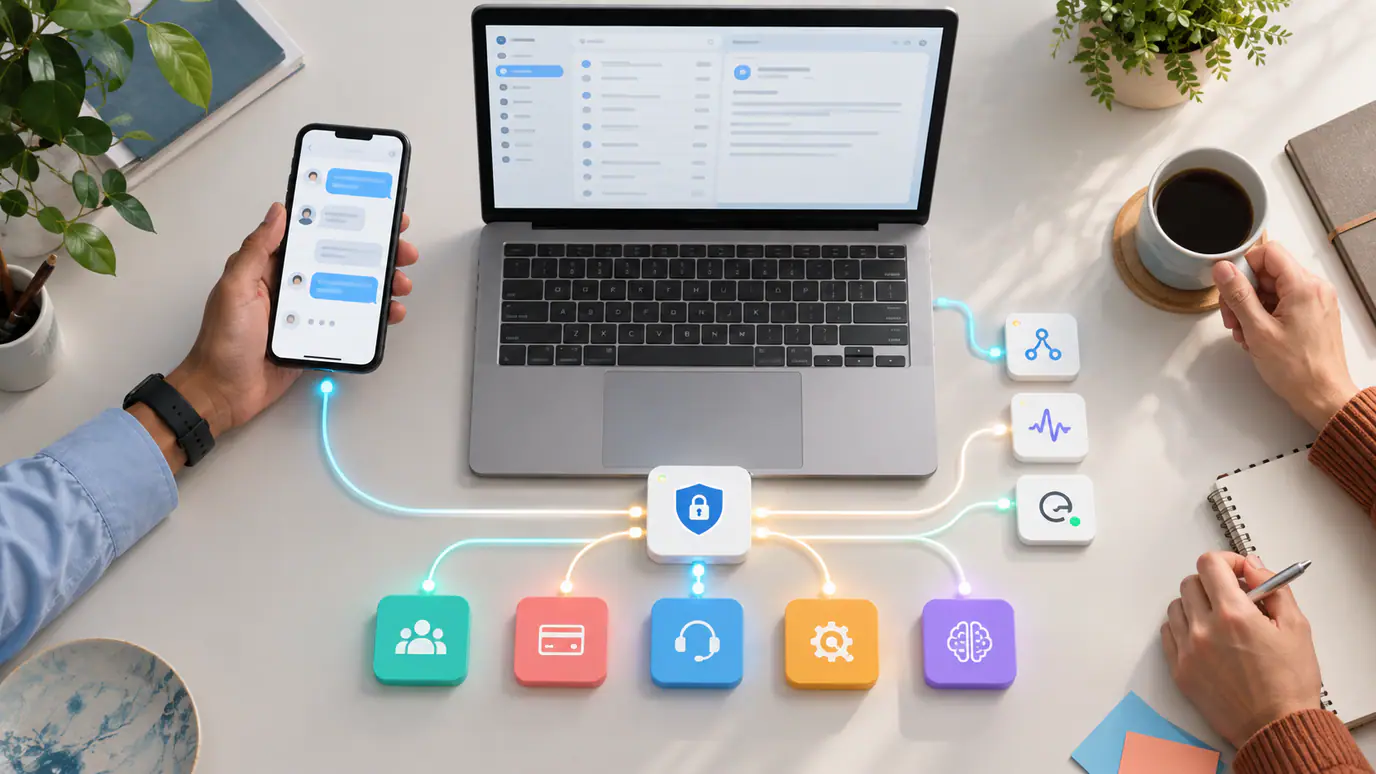
API integration work is becoming AI integration work
According to Postman’s survey of more than 5,700 API professionals in 2025, 89% used generative AI but only 24% actively designed APIs for AI agents. The report also recorded 7.53 million AI-API calls during the preceding 12 months, a 40% year-over-year increase. That gap creates a practical hiring requirement: a developer building for agents should provide machine-readable schemas, predictable typed errors, narrow permissions, usage limits, auditability, and observability rather than merely exposing more endpoints. Postman 2025 State of the API Report
Agent security deserves separate review. In the same survey, 51% cited unauthorized or excessive agent access as a leading concern. Although 70% were aware of the Model Context Protocol, only 10% used it regularly. A candidate should therefore be able to explain how an agent receives tools and credentials, which actions require human approval, how retrieved data is permission-filtered, and how the team detects excessive or unexpected access. RAG experience should include document ingestion, metadata and access controls, retrieval evaluation, citation traceability inside the application, model and embedding costs, and safe re-indexing—not just a chatbot demonstration.
How to vet an API integration developer
A resume or framework quiz cannot show how someone handles distributed failure. Use an architecture discussion, a review of representative code, and a short practical assessment based on a fictional or sanitized integration. If the exercise requires meaningful production-like work, make it paid and limit its scope. The candidate should be evaluated on assumptions, reliability, security, testing, and communication as well as whether the happy path runs.
Practical vetting scorecard for a SaaS API developer
| Competency | Weight | What strong evidence looks like |
|---|---|---|
| Authentication and tenant security | 20% | Chooses an appropriate OAuth flow, limits scopes, separates tenants, protects secrets, validates webhook signatures, and handles refresh, revocation, and expiry |
| Idempotency and failure recovery | 20% | Prevents duplicate side effects, distinguishes retryable failures, bounds retries, preserves failed work, and provides reconciliation and controlled replay |
| Webhooks and asynchronous design | 15% | Acknowledges promptly, processes asynchronously, addresses ordering and duplication, verifies signatures, and explains backpressure |
| Provider constraints | 15% | Handles pagination, rate limits, quotas, sandbox differences, version changes, and provider outages without relying on undocumented assumptions |
| Testing and maintainability | 15% | Uses focused unit, integration, and contract tests; separates transport from business logic; and leaves readable configuration and migration paths |
| Observability and documentation | 15% | Produces useful logs, metrics, alerts, OpenAPI documentation, setup instructions, an operational runbook, and a clear explanation of trade-offs |
A practical assessment that tests production judgment
Ask the candidate to consume customer-update webhooks from a fictional CRM and synchronize them to a SaaS account service. Supply a short API specification containing pagination, a rate limit, occasional 429 and 500 responses, duplicate webhook delivery, and expiring OAuth tokens. Request a small implementation or detailed design, tests for the risky paths, and a brief runbook. Do not require an entire production connector.
- Can the candidate identify missing requirements before coding?
- Does the design acknowledge that webhooks may be duplicated, delayed, or delivered out of order?
- Can it retry safely without creating duplicate customers or repeatedly applying the same update?
- Are credentials excluded from code and logs, and are scopes and tenant boundaries addressed?
- Are rate limits, pagination, timeouts, and provider downtime handled explicitly?
- Do tests cover failure behavior rather than only successful responses?
- Could another developer operate the integration using the documentation and runbook?
- Can the candidate explain what would change at ten times the volume?
Useful interview prompts include: “How would you reconcile missed webhook events?”, “Where should idempotency be enforced?”, “How do you migrate customers when a provider removes an API version?”, and “What information belongs in an alert?” Red flags include unlimited retries, treating HTTP 200 as proof of business completion, storing customer tokens in source code, no plan for duplicate events, dependence on manual database edits, and undocumented assumptions about event order. The practical AI developer assessment guide offers a related framework for evaluating applied technical work.
Dedicated Philippine developer, US employee, Latin America, freelancer, or agency?
Startup-stage hiring decision framework
| Model | Best use | Main trade-off |
|---|---|---|
| US employee | Core platform ownership where close organizational context, local employment, and broad internal collaboration matter | Higher measured wage and benefit cost; recruiting and employment overhead remain separate |
| Dedicated Philippine developer | Continuing integration backlog, written asynchronous work, planned US overlap, follow-the-sun operations, testing, documentation, and maintenance | Requires deliberate overlap, strong written specifications, secure remote access, and clear technical management |
| Latin American nearshore developer | Continuing ownership with more overlap during US working hours | Verified benchmarks in the supplied dataset are higher than the available Philippine industry wage observations, although the measures are not directly equivalent |
| Freelancer | A bounded connector, migration, audit, or short specialist intervention | Hourly price is not comparable with employee salary without normalizing taxes, idle time, management, availability, and continuity |
| Development agency | A defined project needing architecture, design, development, QA, and project management at once | The startup may receive less direct control over individual allocation and long-term product knowledge |
An employee is usually the stronger model for authentication, monitoring, incident response, schema changes, documentation, and vendor migrations that continue after launch. A freelancer is reasonable when the connector is independently deliverable and the startup can accept a handoff. An agency can supply a multi-disciplinary project team, while a dedicated hire accumulates product knowledge and works inside the startup’s backlog. Compare the models in more detail in offshore developers versus a US development agency.
Remote work is established but not universal in the United States: 13.3% of US workers usually worked from home in 2024, down from 13.8% in 2023, according to the US Census Bureau’s American Community Survey guidance. That makes remote-management discipline a real hiring requirement rather than something to assume from a candidate’s technical background.
What does it cost to hire an API integration developer?
There is no single comparable “rate.” Worker salary, employer benefits, recruitment, payroll administration, staffing or employer-of-record fees, equipment, software, cloud and API usage, management time, and replacement costs are different budget lines. Keep them separate. According to the US Bureau of Labor Statistics’ May 2025 data, the median US software developer earned $135,980 annually, or about $11,332 per month, before employer benefits and overhead. US Bureau of Labor Statistics
Documented developer and QA pay or employer-cost benchmarks
| Market and measure | Documented amount | Interpretation |
|---|---|---|
| US software developer wage, May 2025 | $6,872–$17,889 per month from the 10th to 90th percentile; $11,332 monthly median | BLS wage data, not total employer cost. The annual median was $135,980. BLS |
| US private-industry compensation proxy | About $16,130 per month at the US developer median | Applies the June 2025 workforce-wide private-industry benefit-to-wage ratio; it is not software-specific and excludes business overhead. BLS compensation data |
| US software QA analyst or tester wage, May 2025 | $5,120–$13,918 per month from the 10th to 90th percentile; $8,692 monthly median | A separate BLS occupation. Applying the same broad benefit ratio gives an approximate $12,373 monthly compensation proxy before overhead. BLS |
| Latin American developer gross salary, 2025 | $4,417–$5,250 per month average across seven countries | Howdy first-party payroll data; worker salary is distinct from employer or staffing cost. Howdy |
| Latin American employer cost under Howdy’s model | Approximately $5,417 per month | Vendor-reported employer cost, not the worker’s gross salary. Howdy |
| Senior DevOps, AI, or data developer in Latin America | $4,583–$5,833 per month gross worker salary | Howdy’s 2025 senior specialty band; employer-of-record or staffing charges are not included. Howdy |
| Mid-level Latin American full-stack or backend developer | $2,917–$4,000 per month gross worker salary | Howdy’s 2025 band for developers with three to five years of experience. Howdy |
| Junior Latin American Go or React developer | $1,500–$2,333 per month gross worker salary | Howdy’s 2025 junior band; it should not be treated as a senior integration benchmark. Howdy |
| Philippine applications programmer in information services, 2024 | PHP 73,804 per month average wage rate | Industry-specific official wage observation including basic pay and regular or guaranteed cash allowances; not a remote staffing price. Philippine Statistics Authority |
| Philippine software developer in publishing, 2024 | PHP 66,180 per month average wage rate | Industry-specific official wage observation; the source does not provide a verified USD remote-developer rate. Philippine Statistics Authority |
According to the US Bureau of Labor Statistics’ June 2025 compensation data, private-industry benefits equaled 29.8% of total compensation—approximately 42.3 cents on top of each wage dollar—although this average is not specific to software developers. Legally required benefits averaged $3.31 per hour, about 10.3% of wages, and business overhead was not measured. BLS Employer Costs for Employee Compensation
According to Howdy’s 2025 verified payroll dataset, Latin American software developers averaged $53,000–$63,000 in annual gross salary, versus a $135,980 US software-developer median reported by BLS in May 2025. Comparing the Latin American gross salary range with the US median wage produces a 53.7%–61.0% arithmetic difference, but that is not a complete employer-cost comparison. Howdy separately reports approximately $65,000 annually in total employer cost under its model and describes a 60%–65% difference from its approximately $160,000 US fully loaded comparator. These are vendor benchmarks, not BLS estimates. Howdy’s 2025 salary data
- Worker pay: salary or contract compensation received by the developer.
- Employment cost: statutory obligations, benefits, paid leave, insurance, and payroll costs where applicable.
- Provider cost: recruitment, local employment, payroll, HR, administration, and provider margin.
- Operating cost: laptop, security tools, monitoring, development environments, cloud infrastructure, API calls, AI models, and paid SaaS plans.
- Internal cost: engineering management, product clarification, code review, onboarding, incident participation, and knowledge transfer.
- Continuity cost: overlap, documentation, replacement recruiting, access transfer, and work that slows when knowledge sits with one person.
Philippines versus Latin America for SaaS integration work
The decision is not simply offshore versus nearshore. Latin America usually offers more overlap with US business hours and has transparent USD benchmarks in the supplied 2025 payroll dataset. The Philippines offers an established offshore-services base and can support planned overlap or follow-the-sun work, but the official wage source inspected here does not establish a general USD salary for remote API developers. Compare role level, employment model, overlap, English communication, technical evidence, and total employer cost rather than converting one narrow industry wage into a universal rate.
According to the Philippine IT-BPM Industry Roadmap 2028, the sector is targeting approximately 2.5 million direct jobs and $59 billion in annual revenue by 2028 while increasing high-complexity and high-skill work. The roadmap emphasizes digital services, data and analytics, technical reskilling, global in-house centers, and a targeted 13% increase in revenue per full-time equivalent from higher-skill work. It also calls for 54% of new jobs through 2028 to be created outside Metro Manila. Philippine IT-BPM Industry Roadmap 2028
Latin America’s nearshore proposition is also supported by regional investment policy. In June 2022, the Inter-American Development Bank estimated that nearshoring could add $78 billion in annual goods and services exports from Latin America and the Caribbean. That estimate describes a regional opportunity, not a developer salary or a guaranteed startup outcome. Inter-American Development Bank
The wider outsourcing market is moving toward cloud delivery, automation, analytics, domain expertise, and outcome-oriented engagements. Fortune Business Insights valued the global BPO market at $327.01 billion in 2025 and forecast growth from $353.64 billion in 2026 to $741.60 billion in 2034. This commercial forecast demonstrates market direction, not the quality or suitability of any individual developer. Fortune Business Insights
Security, contracts, IP, and international hiring
Before granting access, decide whether the person will be employed through a local entity, engaged as an independent contractor, or employed through a staffing or employer-of-record arrangement. An employer of record acts as the local legal employer and handles local contracts, payroll, benefits, and employment administration; its fee is an employer cost, not worker salary. Direct employment may avoid a provider margin but generally requires suitable local employment and payroll capability. Classification, tax, labor, privacy, and industry requirements depend on the actual arrangement and jurisdictions, so obtain qualified legal and tax advice.
- Put confidentiality, invention assignment, code and documentation ownership, approved open-source use, return of property, and post-engagement access removal in the appropriate agreements.
- Use individual identities, least-privilege roles, managed devices where appropriate, multifactor authentication, a password or secrets manager, and auditable access rather than shared administrator accounts.
- Separate development, test, and production environments; use synthetic or minimized data in assessments and onboarding whenever possible.
- Document which customer and regulated data may cross borders, where logs and backups reside, and which subprocessors receive data.
- Create joiner, mover, and leaver procedures covering repositories, cloud platforms, databases, vendor portals, OAuth applications, signing keys, and customer support tools.
- Require incident reporting, credential rotation, dependency management, vulnerability handling, backup restoration, and evidence retention appropriate to the startup’s risk profile.
International paperwork does not replace technical controls. Likewise, an NDA does not establish secure development practices or resolve worker classification. The legal guide to hiring an AI developer in the Philippines, international payroll guide, and overseas background-check guide explain adjacent decisions without substituting for professional advice.
A 30-60-90-day operating plan
The following is a planning framework, not a delivery promise. Adjust it to the complexity of the system and the developer’s seniority. The goal is to increase access and production responsibility only after the developer demonstrates understanding, safe changes, and effective communication.
Onboarding plan for a dedicated API integration developer
| Period | Primary objectives | Evidence to review |
|---|---|---|
| Days 1–30 | Learn the product, architecture, customers, integration inventory, deployment process, security rules, incident history, and team communication. Reproduce the environment and complete a low-risk change. | Environment setup checklist, architecture notes, corrected documentation, reviewed pull request, passing tests, and a walkthrough of one integration |
| Days 31–60 | Own a bounded integration improvement, add failure-path tests, improve observability, participate in support review, and document operational procedures. | Design note, code review, contract or integration tests, dashboard or alert improvement, runbook, and post-release verification |
| Days 61–90 | Own an integration area under normal review, propose a risk-ranked roadmap, exercise recovery procedures, and transfer enough knowledge that another engineer can respond. | Integration health review, prioritized backlog, replay or recovery exercise, documented credentials and dependencies, and peer knowledge-transfer check |
Set communication expectations explicitly: core overlap hours, response expectations for routine and urgent messages, written daily or weekly updates, pull-request review rules, decision records, escalation paths, and on-call participation if the role includes it. A Philippine hire does not automatically imply night-shift work. Agree on a sustainable schedule and distinguish planned overlap from emergency coverage. Use the overseas employee onboarding checklist to coordinate people, access, equipment, payroll, and documentation.
Measure integration health, not lines of code
Choose a small baseline before the developer starts, then measure trends by integration and customer tier. Avoid holding one developer responsible for provider outages, inherited architecture, or product decisions outside the role. Pair delivery measures with reliability, security, maintainability, and documentation.
- Integration lead time: elapsed time from an approved, sufficiently specified requirement to production acceptance, segmented by complexity.
- Change failure rate: percentage of integration changes that require rollback, hotfix, or incident response.
- Successful processing rate: accepted events or jobs that reach the intended business state, excluding deliberate rejects.
- Duplicate side-effect rate: repeated charges, records, notifications, or state changes caused by replay or concurrency.
- Recovery time: time from detecting a failed flow to restoring processing and reconciling missed work.
- Latency and backlog age: end-to-end processing time plus the age and depth of queued work.
- Incident volume: customer-impacting failures by cause, provider, severity, and recurrence.
- Test and documentation coverage: critical behaviors protected by automated tests and integrations with current setup guides, owners, alerts, and runbooks.
- Vendor-change readiness: upcoming deprecations identified, assigned, tested, and migrated before the provider deadline.
- API and AI operating cost: cloud, vendor, automation-platform, model, and observability consumption per relevant transaction or customer.
Postman’s 2025 survey found that 93% of API teams experienced at least one listed collaboration problem, while only 17% reported contract-testing adoption. Testing, development, and documentation were performed by 81%, 73%, and 58% of respondents, respectively. These figures support treating schemas, automated contracts, decision records, and living documentation as deliverables rather than optional cleanup. Postman 2025 State of the API Report

Continuity and maintenance after launch
An integration is not finished when the first successful payload reaches production. Providers change schemas, permissions, rate limits, endpoints, SDKs, and authentication rules. Customer configurations drift, tokens expire, payloads grow, and previously rare failure paths become routine at higher volume. Assign a named owner, maintenance capacity, alert routing, a deprecation calendar, and a recurring health review.
- Keep source code, deployment configuration, API registrations, documentation, dashboards, and vendor accounts under company-controlled ownership.
- Require reviewed pull requests and avoid allowing one person to be the only production administrator or holder of recovery knowledge.
- Maintain an integration registry listing owner, provider, version, credentials location, data handled, customer dependencies, tests, alerts, runbook, and deprecation dates.
- Test replay, reconciliation, credential rotation, provider outage behavior, and restoration procedures before an incident requires them.
- Budget separately for engineering maintenance, automation-platform plans, cloud resources, monitoring, third-party API fees, and AI-model usage.
- Use periodic knowledge-transfer sessions and require another engineer to follow the runbook so documentation is tested rather than merely stored.
Hiring checklist for SaaS founders
- Classify the work as product API engineering, low-code automation, AI development, or a genuine combination.
- Select one representative integration and document systems, objects, direction, source of truth, volume, security, and failure behavior.
- Decide whether the need is bounded project delivery or continuing ownership and maintenance.
- Set a total budget with separate lines for pay, benefits or employment, provider fees, equipment, software, API usage, management, and continuity.
- Specify required US-hour overlap, asynchronous communication, escalation, and any on-call expectations.
- Screen English communication and reliability alongside technical ability.
- Use an architecture interview, representative code review, and focused practical assessment covering OAuth, webhooks, idempotency, retries, rate limits, tests, observability, and versioning.
- Check references where appropriate, verify identity and employment history lawfully, and do not treat a marketplace rating as sufficient evidence.
- Define ownership, confidentiality, access, data handling, open-source use, documentation, handoff, and offboarding before work starts.
- Agree on 30-, 60-, and 90-day evidence, then measure integration outcomes rather than activity.
A practical next step
Start by writing a one-page brief for the integration that creates the most customer or engineering friction, then score candidates against the same practical rubric. Borderless Recruit can recruit dedicated Philippine talent and handles local contracts, payroll, and HR. Its live catalog lists an Integrations Developer for APIs from $1,500 per month under the AI Automation Specialist service; that is a staffing price, not a Philippine market-salary statistic, and specialty requirements can change the price. Candidates undergo an English interview, reliability assessment, and practical skills screening. Ask for the assessment to reflect your stack, require the resulting code and documentation to remain company-controlled, and make maintenance ownership explicit before selecting a candidate.
Frequently Asked Questions
How much does it cost to hire an API integration developer?
The cost depends on seniority, location, employment model, and scope. BLS reported a May 2025 US software-developer median wage of about $11,332 per month, while official Philippine industry observations reported PHP 73,804 per month for applications programmers in information services and PHP 66,180 for software developers in publishing; salary, benefits, staffing fees, equipment, software, API consumption, and management must be budgeted separately.
What skills should a SaaS API developer have?
Look for evidence in OAuth, authorization, webhooks, idempotency, retries, queues, rate limits, data mapping, versioning, automated testing, observability, and OpenAPI documentation. The candidate should also understand multitenancy, secure credential handling, vendor outages, reconciliation, and the business consequences of failed synchronization.
How do I hire a qualified API integration developer?
Define one representative integration, screen for communication and reliability, review relevant code or architecture, and use a focused practical assessment with duplicate events, expired credentials, rate limits, and provider failures. Score every candidate against the same rubric and verify that the person can document, operate, and maintain the integration—not merely demonstrate a successful request.
Should a SaaS startup hire a freelancer, employee, offshore developer, or agency?
Use a freelancer for tightly bounded work, an agency for a defined multi-disciplinary project, and a dedicated employee or offshore team member for recurring integrations and continuing production ownership. A Philippine developer can suit asynchronous or follow-the-sun operations, while Latin America can offer more US-hour overlap; technical evidence and total employer cost matter more than region alone.
How long does it take to hire and onboard an API developer?
There is no responsible universal timeline because sourcing difficulty, stack, seniority, assessments, notice periods, contracts, equipment, and access all vary. Plan onboarding in controlled stages: product and architecture learning, a low-risk reviewed change, a bounded integration improvement, and then broader ownership after the developer demonstrates safe production judgment.
Can an n8n, Make, or Zapier specialist replace an API developer?
Sometimes, especially for internal workflows using well-supported connectors and moderate volumes. Hire an API developer when the work requires custom authentication, product-facing endpoints, complex data synchronization, multitenant security, high-volume event processing, specialized tests, or code-level control over reliability and performance.