

Customer Support for Shopify Stores: Options & Costs (2026)
August 7, 2026 · Borderless Recruit Team
Customer support for Shopify stores can be handled by the owner, AI, a US employee, or a dedicated offshore agent. A US representative earns $2,557-$5,228 per month before benefits, while current Philippines-based Shopify and Gorgias postings commonly offer $465-$1,000. The right model depends on ticket volume, channel complexity, coverage hours, and refund risk.
What Customer Support for Shopify Stores Actually Includes
Shopify customer support means helping a merchant's shoppers before and after a purchase; it is not the same as Shopify helping the merchant operate the platform. Store-level agents answer product questions, locate packages, modify eligible orders, explain return rules, issue authorized refunds, troubleshoot discount codes, and document complaints. They may also recover canceled orders, flag fraud, collect product feedback, and coordinate with warehouses, carriers, and third-party logistics providers.
The distinction matters because Shopify Support generally addresses platform issues such as billing, domains, checkout configuration, apps, themes, and account access. It cannot decide whether your customer qualifies for a refund or find a package held by your 3PL. Likewise, a shopper who bought from an independent Shopify merchant must contact that store through its email address, contact form, chat widget, social account, or policy pages—not ask Shopify to manage the order.
The responsibilities of a Shopify support queue
- Pre-purchase support: sizing, compatibility, inventory, ingredients, bundles, subscriptions, discounts, and estimated delivery dates.
- Order administration: address corrections, item swaps, cancellations, partial refunds, duplicate orders, gift notes, and fulfillment-status checks.
- Post-purchase support: WISMO inquiries, damaged items, missing packages, return merchandise authorizations, exchanges, and warranty claims.
- Risk and retention: chargeback evidence, fraud escalation, negative-review recovery, VIP treatment, and save offers within approved limits.
- Operational feedback: tagging recurring defects, reporting carrier failures, identifying unclear policies, and sharing customer language with marketing and product teams.
The best agents own the issue through resolution instead of forwarding every exception. That requires controlled access to Shopify, a commerce-aware help desk, documented financial authority, and a clear escalation path. A representative who can inspect an order, verify fulfillment, apply policy, and communicate the outcome in one interaction usually creates less rework than a generic answering service.
Why Shopify Customer Service Matters for Ecommerce Growth
Customer service protects revenue because Shopify stores operate in a large, fast-growing transaction environment where a delayed answer can become a cancellation, chargeback, or public complaint. According to Shopify's 2025 financial results, merchants processed $378.4 billion in GMV during the year—29% more than in 2024—and represented an estimated 14% or more of US e-commerce. Shopify's 2025 GMV was approximately three times its 2020 volume.
The broader market reinforces the point. The US Census Bureau reported $316.1 billion in US retail e-commerce sales during Q4 2025, equal to 16.6% of total retail sales. Customers also look for answers before visiting a merchant's help center: Gartner found that 51% of service journeys began on Google, YouTube, ChatGPT, or another third-party platform in early 2025. The share reached 74% among Generation Z, making accurate policy pages and machine-readable FAQs part of the support operation.
The tickets Shopify teams handle most often
- WISMO, or “Where is my order?” requests caused by fulfillment delays, weak tracking pages, or carrier exceptions.
- Address changes and cancellations submitted after purchase but before a warehouse locks the order.
- Returns, exchanges, refunds, restocking fees, and questions about final-sale merchandise.
- Damaged, incorrect, incomplete, stolen, or apparently lost deliveries that require evidence and replacement rules.
- Discount-code failures, subscription changes, payment problems, duplicate charges, and gift-card questions.
- Product fit, sizing, usage, compatibility, availability, and restock questions that influence conversion.
- Complaints, negative reviews, chargeback threats, and VIP exceptions requiring judgment rather than a generic macro.
Support data should improve the store, not merely close tickets. Repeated sizing questions may justify a better product-page guide; recurring late-delivery contacts may expose an unrealistic shipping promise. Track contact reasons by product, carrier, warehouse, and order value. That turns the queue into an early-warning system for problems affecting conversion, repeat purchases, and margin.
Essential Channels and Tools for Customer Support for Shopify Stores
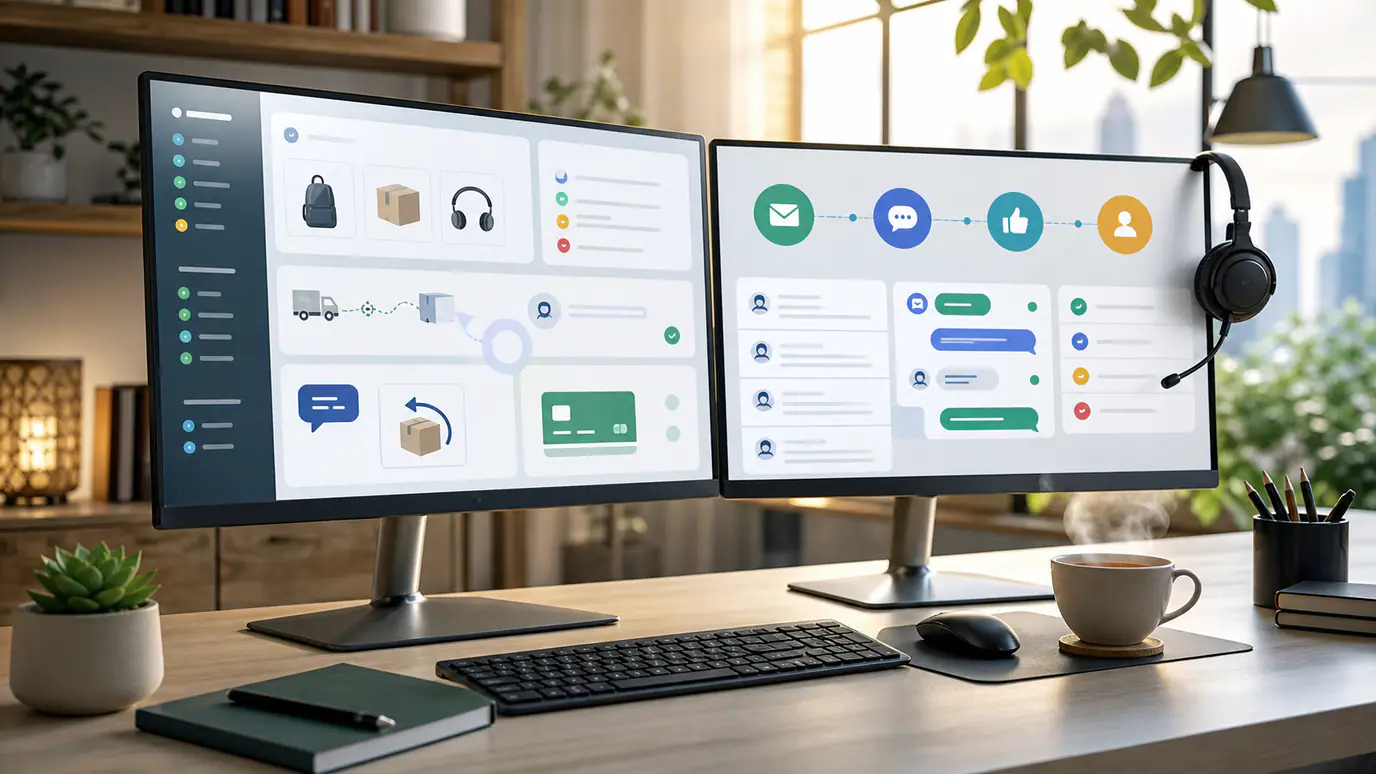
Most small Shopify stores need reliable email, self-service order tracking, and live chat before they need every possible channel. Email suits detailed cases and attachments; chat handles pre-purchase questions and quick order checks; SMS works for urgent updates but requires consent discipline. Phone support is valuable for complex, high-value, or emotionally charged purchases, while social direct messages should be routed into the same help desk so conversations do not disappear in individual accounts.
- Shopify Inbox: a practical native choice for smaller stores needing web chat, automated FAQ answers, and order-status information.
- Gorgias: a commerce-focused help desk offering omnichannel routing, macros, analytics, automation, and Shopify order actions.
- Zendesk: a broad service platform suited to mature workflows, multiple brands, complex routing, and larger reporting requirements.
- Re:amaze: an ecommerce-oriented option combining email, chat, social messaging, FAQs, and customer conversation history.
- Klaviyo: useful for transactional and lifecycle context, but not a substitute for a ticketing system with queue ownership.
- Shipping platforms: tools such as AfterShip, ShipStation, and 3PL portals supply fulfillment events agents need to resolve delivery inquiries.
Shopify Sidekick and Shopify Inbox have different jobs. Sidekick helps merchants work inside the Shopify admin, but Shopify states that it cannot communicate with store customers or conduct support conversations. Shopify Inbox is customer-facing and can provide automated answers and order-status information. Larger operations usually add a specialized help desk because agents need routing, service-level rules, quality reporting, multi-store support, and controlled actions from inside each conversation.
Connecting Shopify to Gorgias, for example, allows an authorized agent to view order history and shipping details and perform actions such as cancellations or refunds without leaving the help desk. Vendor-published results illustrate the potential, although they should not be treated as universal guarantees. Oger reported 61% faster first response and 69% faster resolution, while Try The World increased daily tickets handled per agent from 80 to 120 after reducing application switching.
Automation should remove repetitive work without eliminating access to judgment. According to Salesforce's 2025 State of Service research, AI resolved 30% of customer service cases in 2025 and is expected to resolve 50% by 2027. Yet a 2025 SurveyMonkey study cited by Shopify found that 89% of consumers wanted companies to provide an option to speak with a human. For most merchants, the winning model is human-plus-AI rather than AI-only support.
When to Hire Support and How Many Shopify Agents You Need
Hire dedicated support when the queue regularly interrupts revenue-producing work, customers wait beyond your stated service level, or unresolved tickets spill into the next business day. Monthly order count is useful, but ticket volume and average handle time are better staffing inputs. A store selling technical products may generate several pre-purchase conversations per order, while a replenishment brand with accurate tracking and clear policies may receive far fewer contacts.
Illustrative Shopify support staffing plan
| Observed demand | Practical starting model | Coverage approach | Management priority |
|---|---|---|---|
| Fewer than 15 new tickets per day | Owner, operations employee, or part-time specialist supported by automation | Defined response blocks during business hours | Build policies, macros, tags, and self-service tracking |
| 15-45 tickets per day | One dedicated full-time agent with backup coverage | Single shift plus an urgent-case escalation route | Measure handle time, backlog, CSAT, and contact reasons |
| 45-90 tickets per day | Two agents or one agent plus planned peak support | Staggered shifts for longer daily coverage | Add QA reviews, queue ownership, and workload forecasting |
| More than 90 tickets per day | Multi-agent team with a working lead | Multiple shifts, weekend rotation, and surge capacity | Formal SLAs, workforce planning, coaching, and escalation control |
These ranges are planning prompts, not universal productivity benchmarks. Calculate required labor using your own data: monthly tickets multiplied by average handle time, divided by productive agent hours. Add time for coaching, meetings, documentation, quality reviews, breaks, and unpredictable exceptions. If 1,200 tickets require an average of eight minutes, direct handling alone consumes 160 hours; one nominal full-time seat would have virtually no capacity for non-ticket work or demand spikes.
Coverage should follow customer demand rather than headquarters hours. Staggered shifts can cover early and late US periods without immediately building a 24/7 operation. Weekend rotations are especially useful for consumer brands shipping every day. For product launches, holidays, or viral promotions, forecast contacts from comparable events, freeze nonessential process changes, prepare incident macros, and arrange trained overflow capacity before the campaign begins.
Strong hiring signals include a persistent backlog, founders spending more than 10-15 hours weekly in the queue, inconsistent refund decisions, missed weekend contacts, and rising chargebacks. A freelancer can clear a bounded backlog or rewrite a help center. An employee is usually better for continuous queue ownership, coaching, secure system access, and consistent brand representation.

How Much Shopify Customer Support Costs in 2026
The cost of Shopify support varies sharply by location and employment model. According to the US Bureau of Labor Statistics, customer service representatives earned a median $20.59 per hour in May 2024, while the 10th-to-90th-percentile range was $14.75-$30.16. That converts to approximately $2,557-$5,228 per month in base wages across the disclosed range, with a median near $3,569.
US wages are not the full employer cost. Bureau of Labor Statistics data for private-industry office and administrative-support occupations in December 2025 assigned 68.5% of compensation to wages and 31.5% to benefits. Benefits therefore equaled approximately 46% on top of wages. The standard employer share of Social Security and Medicare alone is 7.65%, according to the Internal Revenue Service; workspace, hardware, software, recruiting, and management remain additional.
US versus offshore Shopify and Gorgias support compensation
| Role and market | US comparison cost | Disclosed offshore pay | Indicative midpoint difference |
|---|---|---|---|
| Frontline Shopify/Gorgias agent — Philippines | $2,557-$5,228 monthly base; estimated $3,733-$7,632 with the BLS office-support benefit load | $465-$1,000 monthly in current full-time Philippines postings | About 86% below the benefit-loaded US midpoint before offshore employment and operating costs |
| Frontline ecommerce support specialist — Latin America | $2,557-$5,228 monthly base; estimated $3,733-$7,632 with benefits | $1,400-$2,400 directional range; one Shopify/Amazon posting offered $960-$1,280 | About 64% below the benefit-loaded US midpoint using the $1,400-$2,400 benchmark |
| Shopify/Gorgias manager — Philippines | $3,422-$8,356 monthly US supervisor base; estimated $4,996-$12,198 with benefits | $1,800-$2,500 in a 2026 hands-on manager posting | About 72% below the benefit-loaded US midpoint |
| Customer support team lead — Latin America | $3,422-$8,356 monthly US supervisor base; estimated $4,996-$12,198 with benefits | $2,500-$2,750 from a disclosed $30,000-$33,000 annual Gorgias band in Buenos Aires | About 66% below the benefit-loaded US midpoint |
Job-board data show how specialization changes pay. A July 2026 Philippines listing offered PHP60,000 per month—approximately $1,017 at PHP59 per dollar—for email support, Shopify order edits, shipping labels, and fulfillment updates. A Latin America role offered $1,800 monthly for Shopify order management, refunds, returns, Gorgias, 3PL coordination, and Eastern Time coverage. Phone work, advanced English, chargeback ownership, weekends, and night shifts can increase compensation.
These figures compare US employee compensation with offshore direct-hire or contractor postings, so the headline gap is not realized savings. Add agency margin or recruiting cost, employer-of-record fees, local statutory benefits, equipment, security, training, paid leave, night-shift premiums, backup coverage, and supervision. The savings calculator can model the fully loaded difference using your intended staffing structure rather than salary alone.
Choose the model around the work. A direct remote employee offers brand immersion and control but requires management infrastructure. A BPO supplies supervision, redundancy, quality assurance, and faster seasonal scaling, although provider margin is higher and personnel may support multiple accounts. If you outsource customer support, specify whether the quoted price buys named dedicated people, pooled ticket capacity, hourly labor, or an outcome such as resolved contacts.
How to Build an Offshore Shopify Support Team
A successful offshore team begins with role design, evidence-based vetting, and a coverage plan—not merely choosing the lowest salary. Define channels, expected volume, shift hours, supported products, refund authority, phone requirements, tools, written-English standard, and escalation duties. Separate frontline service from advanced fraud, chargeback, or technical responsibilities when the risk and skill requirements differ.
The Philippines offers deep English-language service experience and large-scale BPO infrastructure. According to IBPAP data reported by the Philippine News Agency, the Philippine IT-BPM industry generated $38 billion and employed 1.82 million people in 2024. Employment reached about 1.89 million in 2025, while revenue increased to roughly $40 billion. The country holds an estimated 18% of the global IT-BPM market, although US daytime support commonly means an overnight local shift.
Latin America generally costs more but offers stronger overlap with US business hours and potential English-Spanish coverage. According to the Inter-American Development Bank, Latin America and the Caribbean exported $72.9 billion in knowledge-based services in 2023, and the United States was the leading destination market. Other business services, including BPO activities such as customer service, accounted for $50.6 billion, or 69.5%, of those exports.
A practical recruiting and vetting sequence
- Screen for written clarity, reading comprehension, schedule reliability, stable connectivity, and direct Shopify or ecommerce experience.
- Run a live interview that tests spoken English, listening, empathy, ownership, and the ability to explain an unpopular policy calmly.
- Give a paid work sample containing a delayed shipment, an address change, a damaged order, a return request, and a potential chargeback.
- Require candidates to inspect mock order data, choose the correct action, draft a response, assign tags, and explain when they would escalate.
- Check references for attendance and integrity, then verify equipment, backup internet, workspace privacy, and availability for the stated shift.
Do not score the writing exercise only for grammar. Evaluate whether the candidate finds the relevant facts, avoids unauthorized promises, protects margin, shows empathy, and leaves a usable internal note. This reveals operational judgment better than a generic typing test. Gallup found that 28% of remote-capable US employees worked exclusively remotely in Q2 2025, underscoring that remote management practices are now relevant to domestic and offshore teams alike.
Training Agents on Shopify Workflows, Policies, and Brand Voice
Agents become productive faster when training follows real customer journeys instead of presenting disconnected documents. Start with the product catalog, buyer personas, shipping promises, fulfillment sequence, policy boundaries, and economics of refunds versus replacements. Then teach Shopify navigation in a sandbox or controlled account: finding customers, reading timelines, interpreting payment and fulfillment status, adding notes, applying tags, and recognizing actions that require approval.
Document the high-risk workflows first
- Order edits: verify identity, fulfillment status, warehouse lock time, price difference, inventory, tax consequences, and confirmation requirements.
- Cancellations: define the cutoff, warehouse contact method, payment-state check, refund timing, and response if fulfillment cannot be stopped.
- Returns and refunds: confirm eligibility, condition, return window, final-sale status, shipping responsibility, inspection requirements, and refund authority.
- Damaged or missing orders: collect photographs or carrier evidence, check prior claims, choose replacement or refund, and tag supplier or carrier causes.
- Chargebacks: preserve messages, order confirmation, tracking, delivery evidence, policy acceptance, and prior resolution attempts before the response deadline.
- WISMO tickets: surface the latest carrier event, translate it into plain English, distinguish delay from loss, and set a specific next checkpoint.
Brand-voice training should use paired examples showing an acceptable response and a superficially polite but unacceptable response. Define sentence length, contractions, greeting style, prohibited phrases, emoji use, apology rules, and when humor is inappropriate. Macros should supply accurate policy language and required questions, but agents must edit them to reflect the customer's actual order, history, tone, and next step.
Use a graduated authorization model. During the first week, trainees draft responses and observe order actions. Next, allow low-risk contacts and refunds below a defined threshold while a coach reviews samples daily. Expand access only after accuracy, documentation, and judgment remain stable. Cross-train at least one backup before the primary agent takes independent weekend or holiday coverage.
AI can draft replies, summarize long threads, detect intent, translate messages, and automate routine order-status contacts. Deloitte's 2024 Global Outsourcing Survey found that 83% of surveyed executives were already using AI within outsourced services. Keep humans responsible for policy exceptions, fraud, chargebacks, emotionally charged complaints, high-value customers, and any automated action that could create material financial or reputational harm.
Shopify Support SLAs, Metrics, Escalations, and Data Security
A Shopify support operation needs measurable service levels, quality controls, and access restrictions before it scales. Set separate first-response targets by channel rather than one blended number. An illustrative starting SLA might promise chat acknowledgment within five minutes during staffed hours, email response within four business hours, and urgent fraud or fulfillment escalation within 15 minutes. These are internal planning targets, not universal industry benchmarks; adjust them to staffing, product risk, and stated customer promises.
Metrics that reveal service quality and cost
- First-response time by channel and percentile, so a small number of severe delays are not hidden by an average.
- Resolution time and first-contact resolution, segmented by WISMO, returns, damage, product questions, payment issues, and complaints.
- Customer satisfaction, or CSAT, paired with response rate and ticket reason to avoid drawing conclusions from a small voluntary sample.
- Backlog age, reopened tickets, repeat-contact rate, transfer rate, and the percentage of tickets breaching the stated SLA.
- Cost per resolved contact: total support labor, software, management, and vendor cost divided by resolved conversations.
- Refunds, replacements, discounts, chargebacks, retained cancellations, repeat purchases, and support-assisted revenue by agent and reason.
Quality assurance should review a risk-weighted sample rather than only random easy tickets. Score factual accuracy, policy compliance, empathy, completeness, internal notes, correct tagging, and whether the agent chose the least costly fair resolution. Calibrate scores weekly at first so the manager and agents interpret standards consistently. A team lead should also analyze contact reasons and send recurring defects to operations, merchandising, marketing, and fulfillment owners.
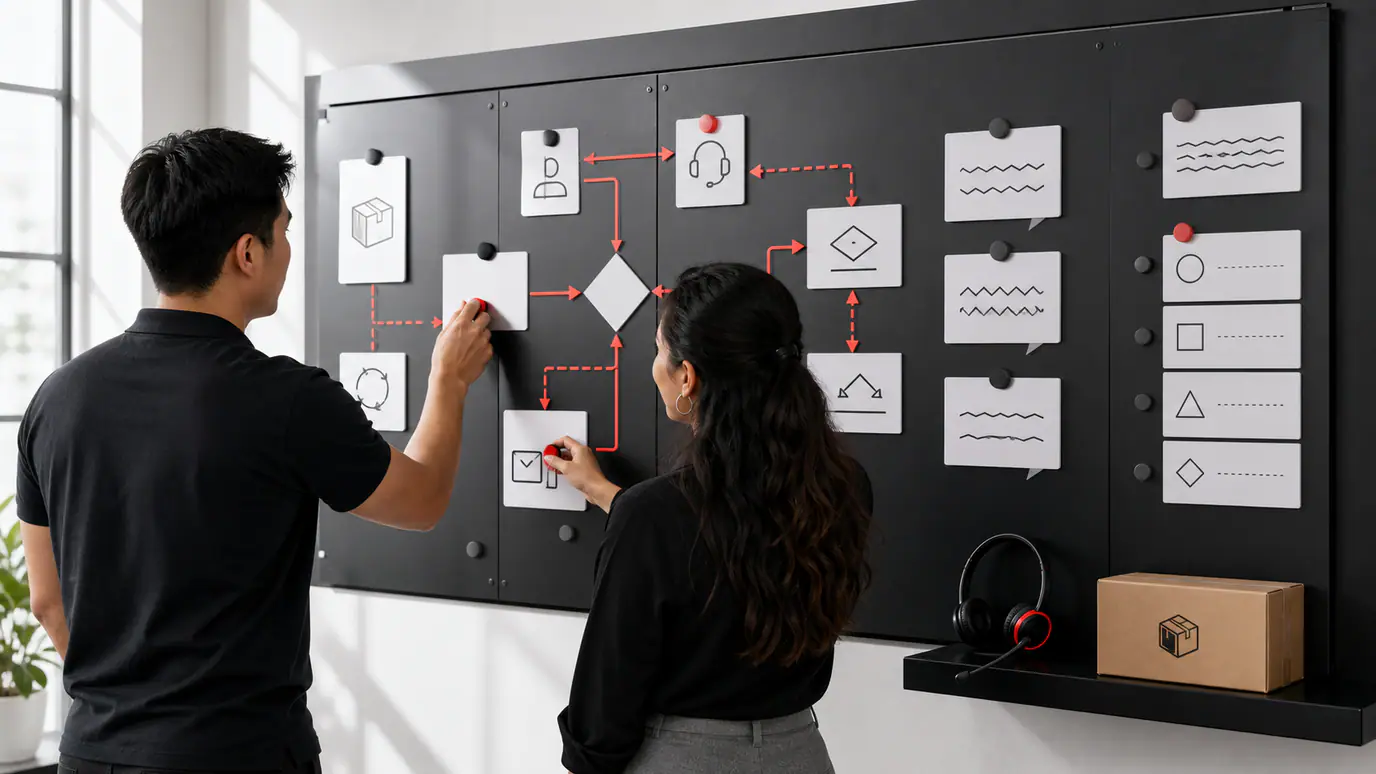
Build an escalation matrix around impact and authority. Frontline agents can handle routine tracking and policy-compliant returns; a lead can approve exceptions and moderate refunds; finance or the founder can own high-value refunds and chargebacks; technical teams can investigate checkout or integration failures. Every escalation should include the order number, verified facts, customer request, actions already taken, financial exposure, deadline, and recommended next step.
For security, give every agent an individual account with the least Shopify permissions needed for the role. Require multifactor authentication, a password manager, approved devices, encrypted storage, automatic screen locks, and immediate access removal at separation. Restrict exports, app installation, theme changes, payouts, user management, and unrestricted refunds. Review Shopify and help-desk audit logs, prohibit shared credentials, and document whether offshore access must use managed devices, single sign-on, or a controlled network.
Agents should never ask customers to send full payment-card data through chat or email. Shopify's hosted payment environment reduces direct exposure, but merchants remain responsible for secure procedures, privacy compliance, appropriate data retention, and vendor oversight. Limit access to the smallest customer-data set necessary, train agents to recognize sensitive information, and create a written incident path for suspicious access, accidental disclosure, phishing, or compromised credentials.
How Borderless Recruit Helps Shopify Stores Scale Support
Dedicated offshore staffing is most useful when a store has repeatable support work, stable weekly demand, and enough management capacity to integrate a full-time employee. The employee should operate as part of the merchant's team, use the merchant's policies and tools, and work defined US coverage hours. That structure offers more brand immersion than a pooled answering service while preserving the labor-cost advantage of the Philippines or Latin America.
Through Borderless Recruit, a dedicated full-time customer support representative starts at $875 per month—well below the estimated $3,733-$7,632 monthly benefit-loaded range for a US employee across the BLS wage distribution. Borderless Recruit conducts a live English interview, personality and reliability assessment, and hands-on skills test, then manages local contracts, payroll, and HR. The service includes a free replacement and a refund for days not worked.
Review the customer support service page to understand the dedicated-agent model, then use the contact page to discuss ticket volume, Shopify and Gorgias experience, shift coverage, phone requirements, and refund authority. If customer support for Shopify stores is consuming founder time or missing stated service levels, bring a 30-day ticket export to the consultation so staffing can be based on actual demand rather than order count alone.
Frequently Asked Questions
Does Shopify have 24/7 customer service?
Shopify provides merchant support resources through its Help Center, but the human contact options shown can depend on the account, plan, region, and issue. Shopify Support assists merchants with the platform; it does not provide 24/7 order service to shoppers who purchased from an independent Shopify store.
How do I talk to a human at Shopify?
Sign in to the Shopify Help Center, select the relevant store and issue, and follow the contact choices offered for your account. If you are a shopper asking about an order, contact the merchant using the store's email address, contact form, chat widget, social profile, or order-confirmation details.
Can I call Shopify customer service?
Shopify does not operate a general consumer phone line for resolving purchases from independent merchants. Merchants should sign in to the Help Center and use the support channels presented for their plan and issue; shoppers must contact the store that accepted the order.
How do I add customer support to my Shopify store?
Start with a monitored support email, visible contact page, shipping and return policies, self-service tracking, and Shopify Inbox or another chat tool. Add a commerce-aware help desk such as Gorgias, Zendesk, or Re:amaze when multiple channels, agents, stores, automation rules, or reporting requirements make a shared inbox unreliable.
When should a Shopify store hire a customer support agent?
Consider a dedicated agent when founders spend 10-15 hours per week answering tickets, the queue repeatedly survives into the next business day, or inconsistent refund decisions create complaints and chargeback risk. Use monthly ticket volume and average handle time to calculate staffing; order count alone does not show how much support work the store generates.